
English
Views: 0 Author: Site Editor Publish Time: 2026-07-07 Origin: Site


Blind trenching and reactive pipe repairs consistently drain operational budgets. They also extend costly facility downtime unnecessarily. Digging up yards, tearing through concrete, or disrupting traffic just to find a suspected issue is no longer an acceptable standard. Modern infrastructure management demands exactness.
Pinpointing exact locations of grease build-ups, root intrusions, and localized oxidation requires specialized diagnostic hardware. You cannot permanently fix what you cannot accurately see. Sending crews out blindly often results in misdiagnosed problems and repeated call-backs. Professionals need precise visual evidence to prescribe the correct mitigation strategy before any excavation begins.
This guide breaks down how to evaluate and select the correct diagnostic equipment for your specific needs. We explore key hardware features, deployment strategies, and supplier evaluation metrics. By the end, you will understand how to shift your operations from reactive digging to precision, evidence-based maintenance using a high-quality Pipeline Inspection Camera.
Precision Diagnostics: Modern inspection cameras distinguish between soft blockages (grease/debris) and structural degradation (corrosion/scaling) before excavation.
Form Factor Matters: Choosing between push-rod systems and robotic crawlers depends entirely on pipe diameter, negotiation angles, and deployment environment.
Material Durability: Anti-oxidation and all-metal camera heads are non-negotiable for highly corrosive sewer environments.
Supplier Support: Procuring the hardware is only step one; evaluating a pipeline inspection camera supplier requires vetting their warranty, calibration services, and spare parts availability.
Waiting for a pipe to back up or collapse triggers a cascade of expensive reactions. Exploratory digging requires heavy machinery and large labor crews. Direct costs add up rapidly when teams must cut through asphalt or trench deeply into soil just to locate a fault. Surface restoration often costs more than the pipe repair itself.
Indirect costs inflict even deeper financial wounds. Commercial facilities experience severe downtime during unexpected sewer failures. Restaurants, manufacturing plants, and hospitals cannot operate without functioning wastewater lines. Furthermore, unaddressed sewage spills often lead to steep municipal fines and environmental compliance violations.
Visual inspection prevents catastrophic failures. Routine diagnostic checks catch minor defects before they escalate. Plumbers and municipal workers can identify early-stage micro-cracking along concrete pipe walls. They can spot minor root intrusions penetrating weak joints. They can observe early-stage oxidation flaking off cast-iron surfaces.
Addressing these issues early allows for less invasive repair methods. Trenchless technologies, like cured-in-place pipe (CIPP) lining, require intact structural integrity to work properly. Catching degradation early ensures trenchless rehabilitation remains a viable option.
A successful inspection eliminates guesswork completely. It moves operations away from vague statements like, "We think the pipe is blocked here." Instead, modern diagnostics provide concrete answers. Success means delivering the exact depth of the obstruction. It means providing precise XYZ coordinates.
Furthermore, success requires capturing clear visual evidence of the problem. High-resolution video proves the necessity of a repair to skeptical clients. It transforms a subjective recommendation into an objective, undeniable fact.
Sewer environments are pitch black and highly reflective. Navigating these spaces requires exceptional lighting and advanced optics. High-lumen, adjustable LED rings illuminate the darkest pipe sections. Operators must control light intensity to prevent glare on wet surfaces.
High-definition sensors capture the actual texture of pipe walls. This clarity remains crucial for accurate diagnoses. Smooth, gelatinous surface sludge looks very different from the sharp, pitted textures of severe corrosion. Without HD optics, operators easily misdiagnose structural degradation as a simple grease blockage.
Different blockages present unique visual markers. Recognizing them quickly speeds up the remediation process.
Root Intrusions: Tree roots usually enter through faulty joints. They create dense, web-like masses catching debris.
Structural Sags: These are often called "bellies." They occur when ground shifting causes a pipe section to sink. Cameras detect them by revealing standing water pooling in specific areas.
Lateral Line Intrusions: Sometimes a secondary pipe protrudes too far into the main line. This catches solid waste and causes rapid backups.
Structural degradation requires entirely different repair strategies than soft blockages. Visual symptoms vary by pipe material. Hydrogen sulfide (H2S) gas damages concrete pipes severely. This gas attacks the crown (top) of the pipe, causing the concrete to crumble away and expose reinforcing rebar.
Cast iron pipes suffer from tuberculation. This condition creates large, rust-colored nodules inside the pipe. These nodules restrict water flow and eventually cause the pipe bottom to rot out completely. Recognizing these specific oxidation flaking patterns prevents crews from attempting high-pressure jetting, which could obliterate a weakened pipe.
Seeing a defect is only half the battle. You must also know exactly where it sits underground. Modern cameras feature built-in transmitters called sondes. These devices typically broadcast at a 512Hz frequency. This specific frequency penetrates dense materials like cast iron, concrete, and deep soil effectively.
Above-ground crews use handheld locators to pick up this signal. They walk the surface and sweep the area until they pinpoint the strongest signal. This method allows teams to map the exact XYZ coordinates of the detected defect. They mark the ground right above the problem, ensuring excavation teams dig in the precise spot needed.
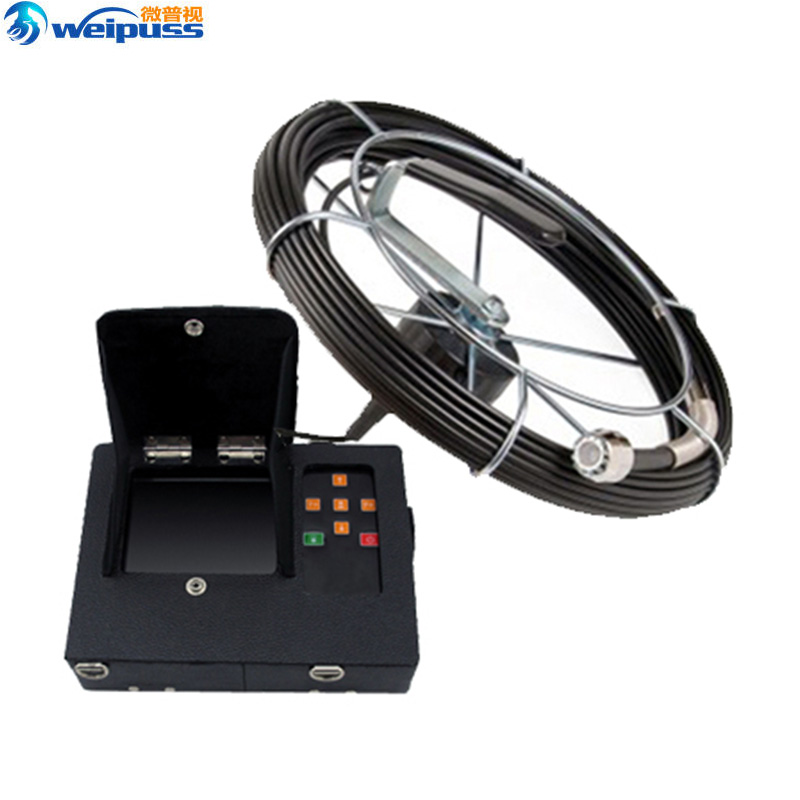
Pipe diameter dictates your equipment choice. Smaller lines demand flexibility, while massive mains require sheer motive power.
Push-Rod Cameras work best for navigating tight traps and smaller diameters. They excel in pipes ranging from 2 to 6 inches. Operators manually feed a stiff fiberglass cable into the line. You must evaluate the cable's rigidity-to-flexibility ratio carefully. A cable too flexible will buckle and loop upon itself. A cable too rigid will not negotiate 90-degree bends.
Robotic Crawlers dominate municipal and industrial settings. Lines measuring 8 inches or wider swallow push-rods easily, but manual pushing distances remain limited by friction. Crawlers feature motorized wheels or tracks. Operators drive them remotely down vast stretches of pipeline. They negotiate debris and minor obstacles using pure torque.
Hardware Form Factor Comparison | ||
Feature | Push-Rod Systems | Robotic Crawlers |
|---|---|---|
Target Pipe Diameter | 2 to 6 inches | 8 inches and larger |
Propulsion Method | Manual feed by operator | Motorized remote control |
Navigation Strength | Excels in tight bends / P-traps | Excels in long, straight runs |
Maximum Range | Typically 100 to 300 feet | Often 1,000+ feet |
Sewer environments destroy fragile electronics. High build quality is not a luxury; it is a baseline requirement. Your equipment must carry an IP68 waterproof rating. This rating guarantees the camera head survives continuous immersion under pressurized water.
Furthermore, standard plastics degrade quickly when exposed to caustic sewer gases and abrasive debris. You need all-metal, anti-oxidation camera housings. Stainless steel provides excellent corrosion resistance. Sapphire glass lenses protect the delicate optics from scratching as the camera drags across rocks and broken concrete.
Modern clients expect professional documentation. Submitting a handwritten note is no longer sufficient. High-end systems feature Wi-Fi enabled monitors. These screens allow operators to stream live footage to a tablet or smartphone.
On-screen distance counters are mandatory. They display exact footage or meter readouts directly over the video feed. Integrated software helps operators generate client-ready diagnostic reports instantly. You capture screenshots, type notes over specific frames, and export a polished PDF before leaving the job site.
The primary advantage remains non-destructive inspection. You locate buried infrastructure issues without moving a single shovelful of dirt. This technology preserves expensive landscaping, concrete driveways, and municipal roads.
Exact fault location drastically reduces repair times. Plumbers dig a localized hole rather than an exploratory trench. Additionally, cameras verify cleaning and repair success. Post-jetting inspections prove to the client that the line is completely clear. Post-lining inspections verify that a newly installed trenchless sleeve sealed perfectly.
Visual diagnostics have strict limitations. Operators must acknowledge these boundaries to set proper client expectations.
Murky Water Blindness: Cameras cannot "see" through solid sludge or thick, standing water. Dark water absorbs LED light completely. Severe blockages require pre-jetting or bypass pumping before an inspection can occur.
Wall Thickness Measurement: Standard optical cameras detect surface degradation effectively. However, they cannot measure exact remaining pipe wall thickness. Determining structural density requires expensive ultrasonic or laser profiling add-ons.
Hidden Leaks: Cameras spot visual cracks. They do not see microscopic pressure leaks directly. Pinpointing tiny pressure drops often requires supplemental dye tests or acoustic listening devices.
Deploying this hardware involves notable field risks. Operators face a distinct learning curve.
Navigating Complex P-traps: Forcing a camera head through a tight trap often kinks or snaps the fiberglass push-rod. Operators must learn the tactile feedback of the cable to avoid breakage.
Equipment Entrapment: Pushing a camera into a partially collapsed line poses severe risks. If debris shifts behind the camera head, the equipment becomes wedged. Retrieving a stuck camera often forces an immediate emergency excavation.
Cross-Contamination: Moving equipment from a raw sewage line to a potable water area is dangerous. Proper post-inspection sterilization protocols remain absolutely vital. Crews must sanitize cables, skids, and monitors meticulously after every deployment.
Procuring diagnostic hardware represents only the first step of the journey. Inevitably, field equipment breaks. Push-rods snap under extreme tension. Skids shatter against jagged concrete. When this happens, replacement speed matters immensely.
Ask potential suppliers about their domestic inventory. Do they stock replacement cables, centering skids, and spare camera heads locally? If you must wait weeks for parts to ship internationally, your business loses money every single day. A reliable Pipeline Inspection Camera supplier guarantees rapid parts dispatch to minimize your downtime.
Sensitive optical sensors and transmitting sondes degrade over time. They require lifecycle support to maintain accuracy. Dropping a camera head repeatedly can knock the 512Hz sonde out of calibration. Ask the supplier about their service center capabilities. Determine if they offer routine maintenance packages to recalibrate transmitters and pressure-test waterproof seals.
Never accept a warranty at face value. You must read the fine print to evaluate its true transparency. Ask the supplier exactly what actions void the agreement. Does opening the monitor casing void it? Does pushing the cable through a specific pipe material void it?
Furthermore, the best suppliers provide initial operational training. Handing an expensive crawler to an untrained crew guarantees immediate field breakage. Proper onboarding prevents costly mistakes during the first few weeks of ownership.
Never purchase expensive diagnostic gear based solely on a spec sheet. Always demand a proof of concept. Request an in-person field demo if possible. If a demo is impossible, ask the supplier for unedited, raw video footage.
Make sure this footage comes from the exact model you intend to buy. Ensure they recorded it in a comparable sewer environment, not a pristine test pipe. Reviewing raw footage reveals the true optical clarity and light distribution you can expect in the field.
Selecting the right diagnostic camera transforms pipe maintenance completely. It elevates your operation from a chaotic guessing game into a predictable, manageable process. You protect operational budgets by eliminating unnecessary exploratory digging. You also build immense client trust by providing undeniable visual evidence of subterranean problems before recommending costly repairs.
Your immediate next step requires an internal audit. Review your most frequent job sites. Audit your most common pipe diameters and typical environmental hazards. Use this data to determine if a rigid push-rod system or a heavy-duty robotic crawler forms your baseline requirement. Partner with a transparent supplier, prioritize robust material durability, and empower your crews to diagnose infrastructure with absolute certainty.
A: Maximum distance depends on the form factor. Standard push-rod lengths typically range from 100 to 300 feet. Friction prevents manual pushing beyond this limit. Robotic crawler systems utilize motorized tracks and spooled tethers, allowing them to traverse municipal mains stretching 1,000 feet or more from a single entry point.
A: They detect the visual defects that cause leaks, such as cracked concrete, separated joints, or heavy corrosion. However, standard optical cameras cannot see or hear microscopic pressure leaks on their own. Finding invisible pressure drops usually requires supplemental acoustic listening equipment or fluorescent dye testing.
A: Operators protect delicate lenses by installing centering skids or wheeled guides around the camera housing. These attachments keep the lens suspended away from the abrasive pipe floor. Additionally, high-end models utilize scratch-resistant sapphire crystal lens covers, which withstand impacts against sharp concrete and jagged rust far better than standard glass.
A: Built-in camera sondes typically transmit at a 512Hz frequency. The industry standardized on 512Hz because this specific lower frequency penetrates dense materials exceptionally well. It easily pushes through thick cast iron, heavy concrete, and dense clay soils to reach the above-ground handheld locator receiver.


